
One of the core objectives of the charity Bath Astronomers is to provide tangible experiences of astronomy and related science, technology, engineering and mathematics (STEM) topics for the local and wider community. It is to aid the understanding of space science, inform about what is going on, and encourage participation in STEM-based careers.
To achieve this, the charity relies of volunteers and supplies them the resources they need.
There are several types of volunteering available:
- Supporting Public and Young Peoples’ Outreach
- Supporting Stargazing and Solargazing
- Supporting Planetarium Presentations
See more about each one below.
Public and Young Peoples’ Outreach
The first is the simplest to get involved in and involves attending events throughout the year and using a resource box(es) provided by the charity to run a STEM-based activity for people to participate in and enjoy. Examples include paper rocket making and launching, crafting planispheres, making constellations, and constructing simply telescopes. Materials and instructions are provided in the boxes. Events usually have a lead volunteer who ensures boxes are delivered, volunteers know what they are doing, and is there to ask help from/escalate to.
Events can include school space evenings, local fetes and fairs, Rainbows, Beavers, Brownies, Cubs, Guides, and Scouts group nights, and exhibitions/displays. There are 10 to 20 events like this per year and can last from 1 to 7 hours.
These activities are designed so no prior knowledge is required. Volunteers may find the experience more rewarding if they know a little about the scientific principles involved in each of the activities i.e. for paper rocket making and launching, knowing Newton’s 3rd law or principles of aerodynamics is useful when encouraging people to think about the activity.
Stargazing and Solargazing
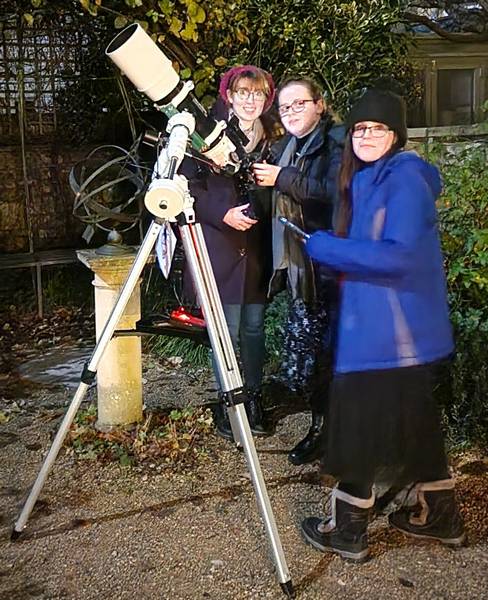
Volunteering for Stargazing and Solargazing requires some skills and knowledge to safely operate the equipment. Training is periodically provided by Bath Astronomers to keen volunteers and those volunteers need to maintain those skills by keeping involved through the year. Events can include public stargazing at various sites in and around Bath, pop-up solargazing in the centre of Bath, afterschool stargazing, or supporting the Herschel Museum of Astronomy with stargazing in the garden of 19 New King Street, Bath.
At its simplest, Stargazing and Solargazing can involve directing members of the public and chatting to them about space whilst they are waiting to look through astronomical equipment. It often includes crewing a particular piece of equipment to ensure visitors know how to use it and checking it is still on target in case it is moved or the target drifts out of the field of view. Lead volunteers will often set up equipment beforehand and pack it up, but acquiring these skills by repetition is an amazing way to build your knowledge and confidence as a volunteer. As operating in low light conditions or with concentrated solar rays presents a heightened risk to the public, all volunteers need to be mindful of those risks and take responsibility for keeping people safe.
It might seem that volunteers doing stargazing or solargazing need to be amazingly knowledgeable. This is not the case. The guidance here is you simply need to know a little more than most of the public attending and as equipment is pointed at one target, it’s a little more about one thing. This extra knowledge can be gleaned from a stargazing app on your phone or reading a Wikipedia article before the public arrive. As volunteers help at more events, this knowledge sticks and so this prep can be skipped.
As the weather needs to be clear and fine for these events to go ahead, experienced volunteers often prepare and give space/STEM-based talks to the public if conditions are inclement. Usually one volunteer at an event will need to be prepared to give a talk for 20 to 30 minutes. This is agreed before the event. Existing presentations are available to those that would like to try this out.
There are 12 to 25 events like this per year and can last from 1 to 3 hours.
Planetarium Presentations
Volunteering for Planetarium Presentations is perhaps the most involved of our opportunities but can be the most rewarding.
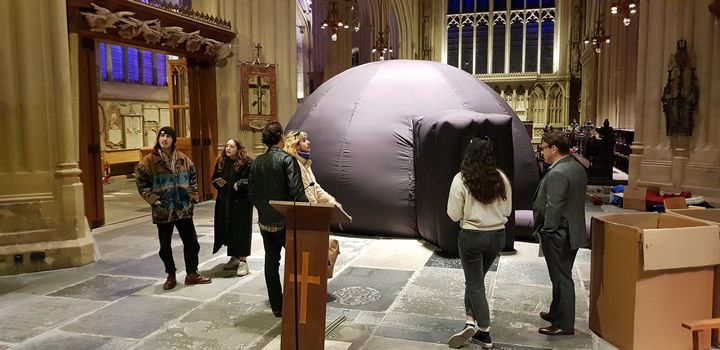
The 5 metre diameter planetarium can be inflated inside buildings and its projection system display recorded shows or virtual stargazing using a free program called Stellarium. Volunteers start out by learning how to run the projection system and how to brief people to get them in and out of the dome safely including emergency evacuation procedures. With this base experience, volunteers can then learn to set out the parts of the dome, inflate it and set up the projection system as well as the reverse to pack it up. The final level of experience is diagnosing issues with the projected images, the sound or the inflation of the dome.
Volunteers start out presenting pre recorded shows in the dome. As experience builds, they can then run live interactive virtual stargazing using the tools and software provided.
There are 10 or so events like this per year lasting a couple of hours. The dome takes 45 minutes to set up and 30 minutes to pack away. Some parts are 15 to 20 kgs and bulky and so need care when lifting.