

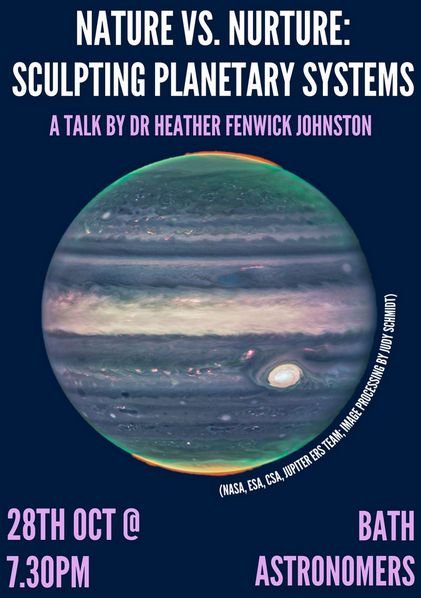
On Wednesday 28th October, we’re delighted to be joined by Dr Heather Johnston of the University of Exeter for a talk entitled “Nature vs. Nurture: Sculpting Planetary Systems”.
Reserve your seat using: https://bathastronomers.org.uk/2026_dr_heather_johnston
Every planetary system begins as a swirling disc of gas and dust around a young star. Over a few million years, this disc disappears, leaving behind planets, asteroids, comets, and a faint debris disc – rather like dust left behind on a construction site. But stars do not form alone. Most are born in crowded stellar nurseries, where intense ultraviolet radiation from nearby massive stars strips away material from the disc, while streams of infalling gas can simultaneously replenish it. My research addresses whether a planetary system’s final architecture is governed primarily by internal processes (nature) or external environmental processes (nurture).
About Dr Heather Johnston
Dr Heather Fenwick Johnston is a postdoctoral researcher at the University of Exeter where she works on all things to do with planet formation and evolution – everything from asteroid belts and meteorites to building giant planets like Jupiter. She completed her undergraduate degree in Physics at the University of Dundee in 2020 and her first research project was studying spots in young stars. She then moved to the University of Leeds to do her PhD in planet formation around different kinds of stars and got her doctorate in 2024, before moving to the south west where she now works.